Japanese School
2025
Medium: Tape on rice-sacks
Dimensions: 1x20 meters
Location: KUMANONISUMU! 2025, Mie, Kumano
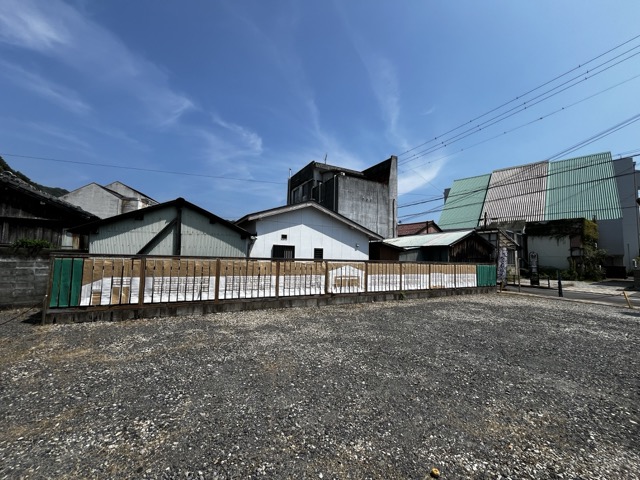
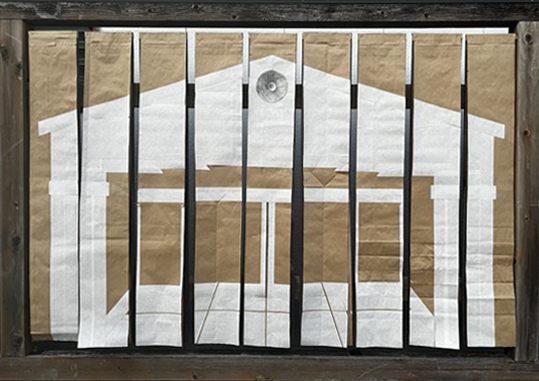
This large-scale installation recalls the former Junior High School in Kamikawa, abandoned for almost two decades. Composed of paper strips cut from rice sacks, the work unfolds along the wooden fence in the center of Kinomoto. Each strip follows the shape of the plank, tracing its structure and clinging to the surface like a second skin. Out of this simple rhythm of material, form, and repetition emerges the silhouette of the deserted school – pieced together like a puzzle.
The warm, earthy tone of the rice sack paper blends with the texture of the wood, while the white tape that geometrically traverses its surface gestures toward the symbolic presence of white in the region’s temples and rituals. In this way, Tabatadze refers to Japan’s cultural relationship to wood and its aesthetic resonance – a relationship that has long captured her attention. The former school building serves not only as the conceptual starting point of the work but also as a personal site: during Tabatadze’s residency, the abandoned classrooms became her studio and place of labor. Its emptiness stands as a metaphor for the region’s demographic shifts and the departure of younger generations. To weave these resonances into the piece, the artist invited the local community to write their thoughts and associations on the old classroom blackboard – messages that now reappear, inscribed in the installation.
Exposed intentionally to weather and time, the work is meant to live and decay with its surroundings. The multilayered rice sacks – originally used to store harvested grain – flutter in the wind, absorb the traces of weather, and slowly fade. In this subtle process, the installation becomes a temporal image: a memory of a building and a community, yielding itself to change, impermanence, and dissolution.
Text by project curator: Tina Natsvlishvili